Description

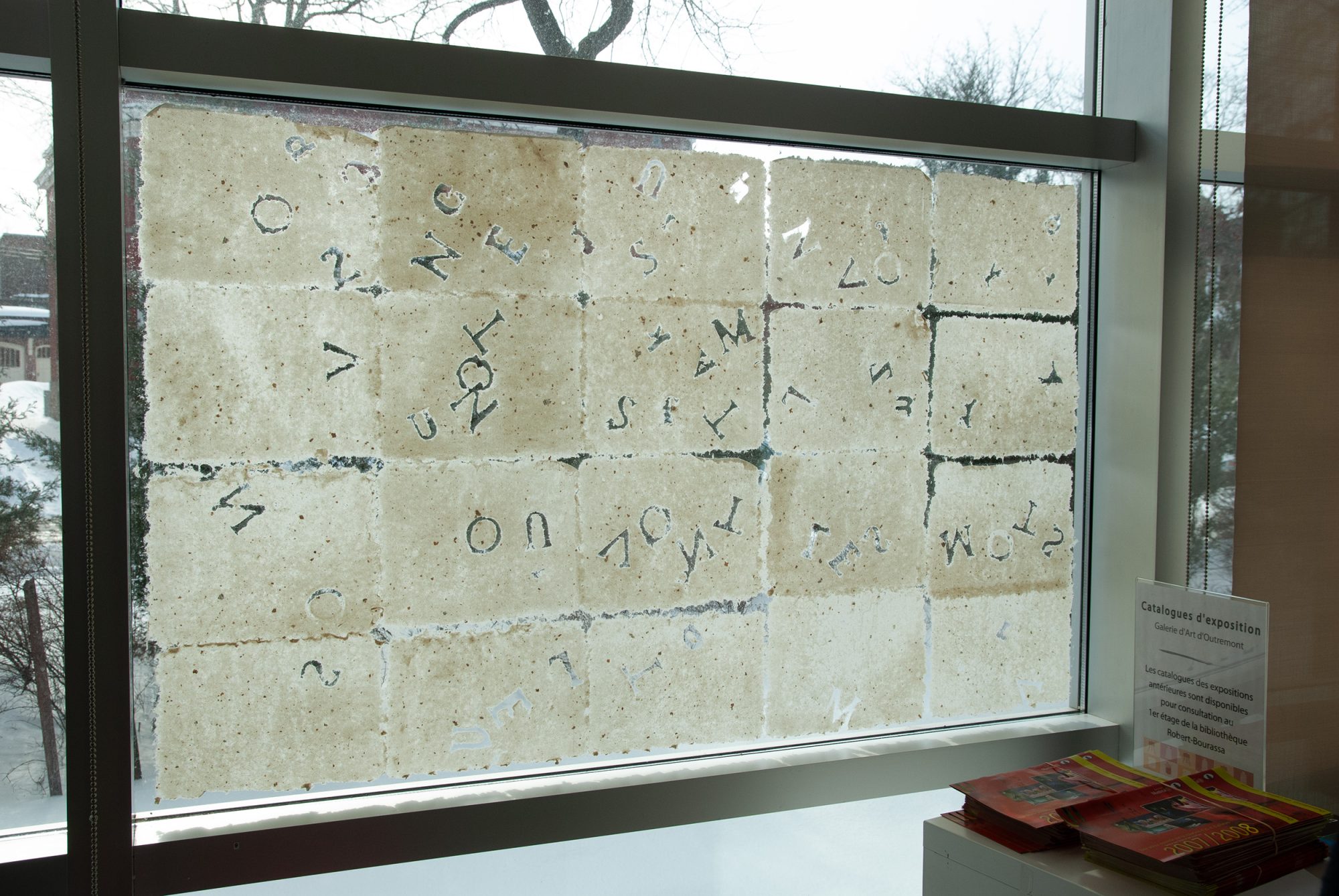
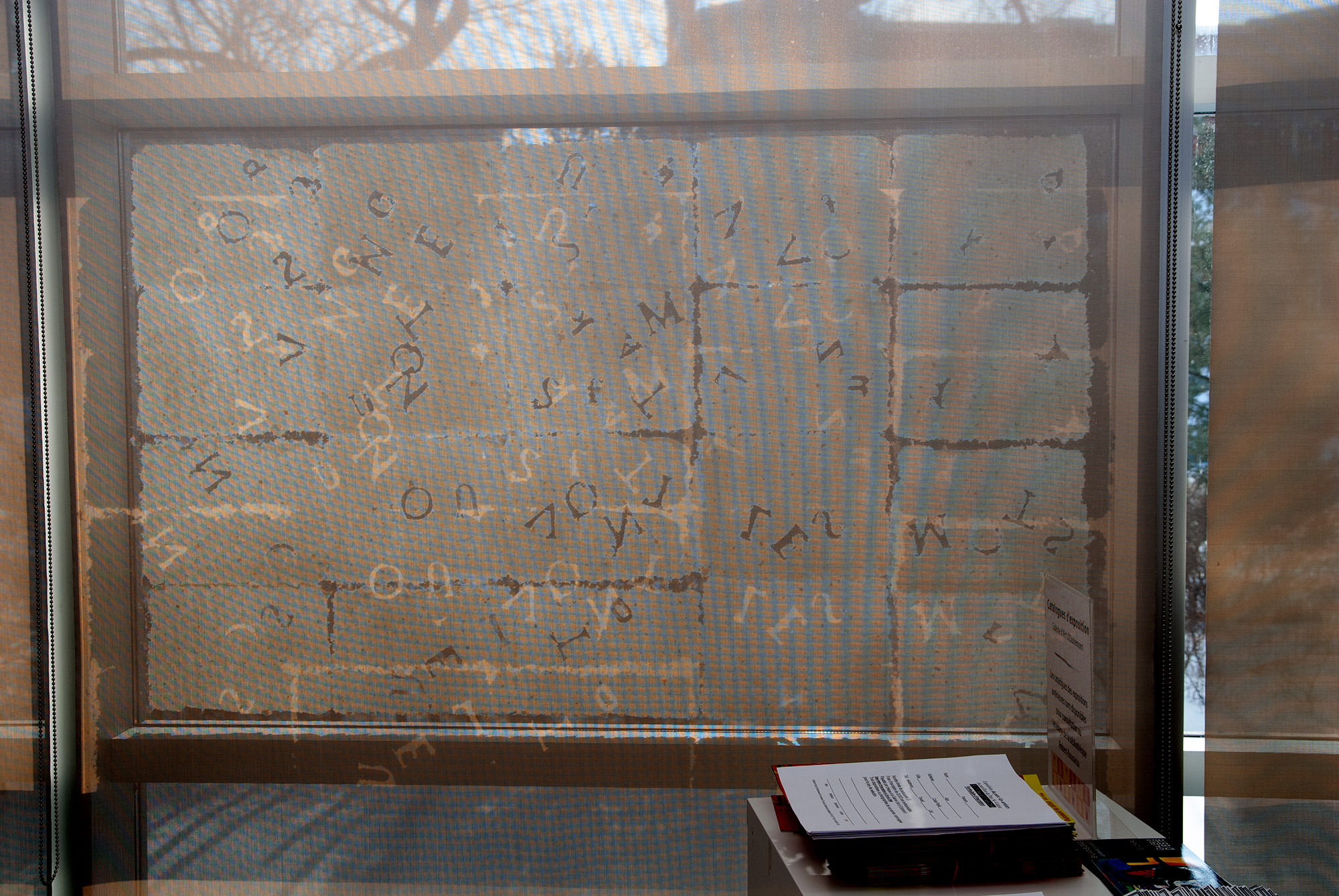
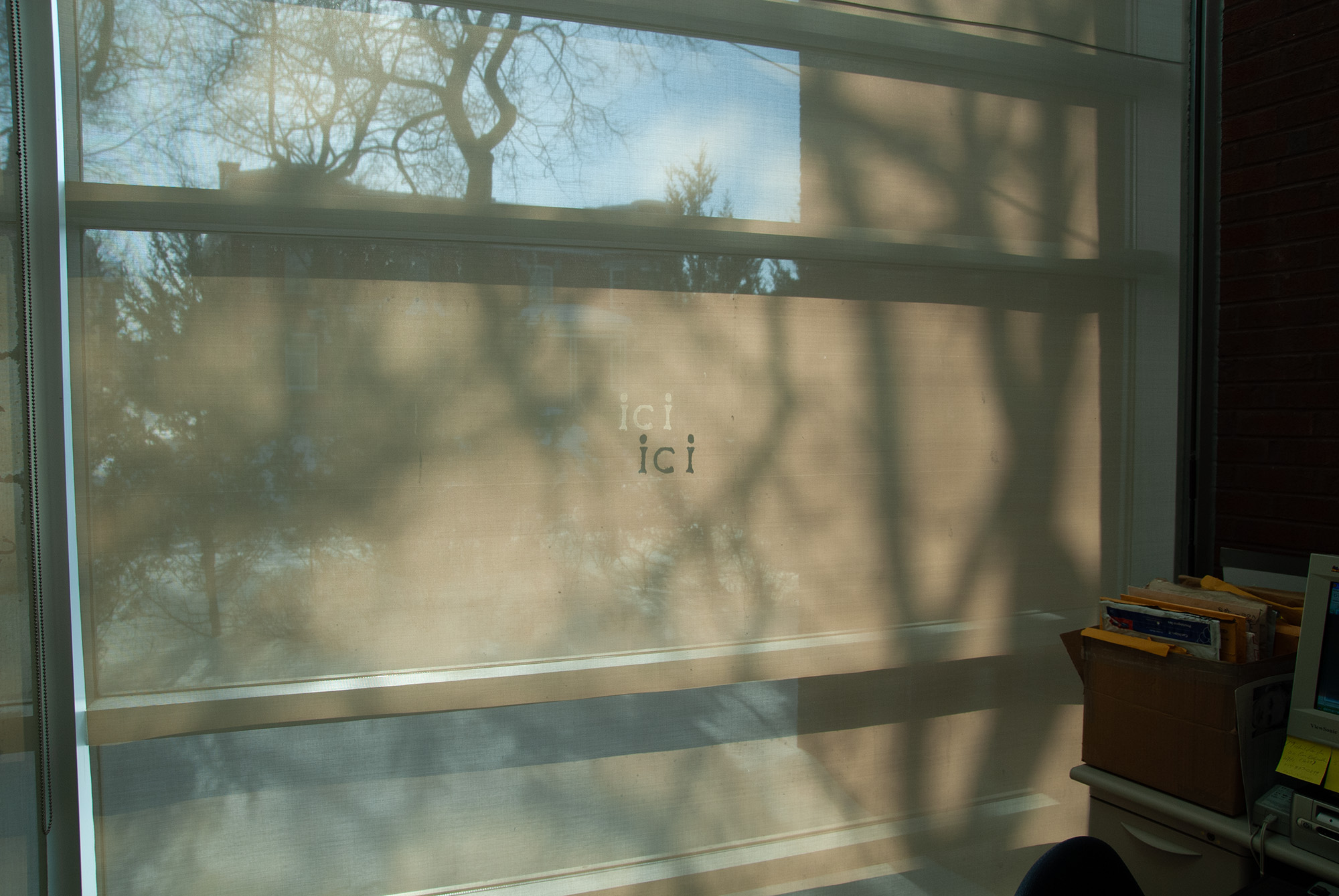
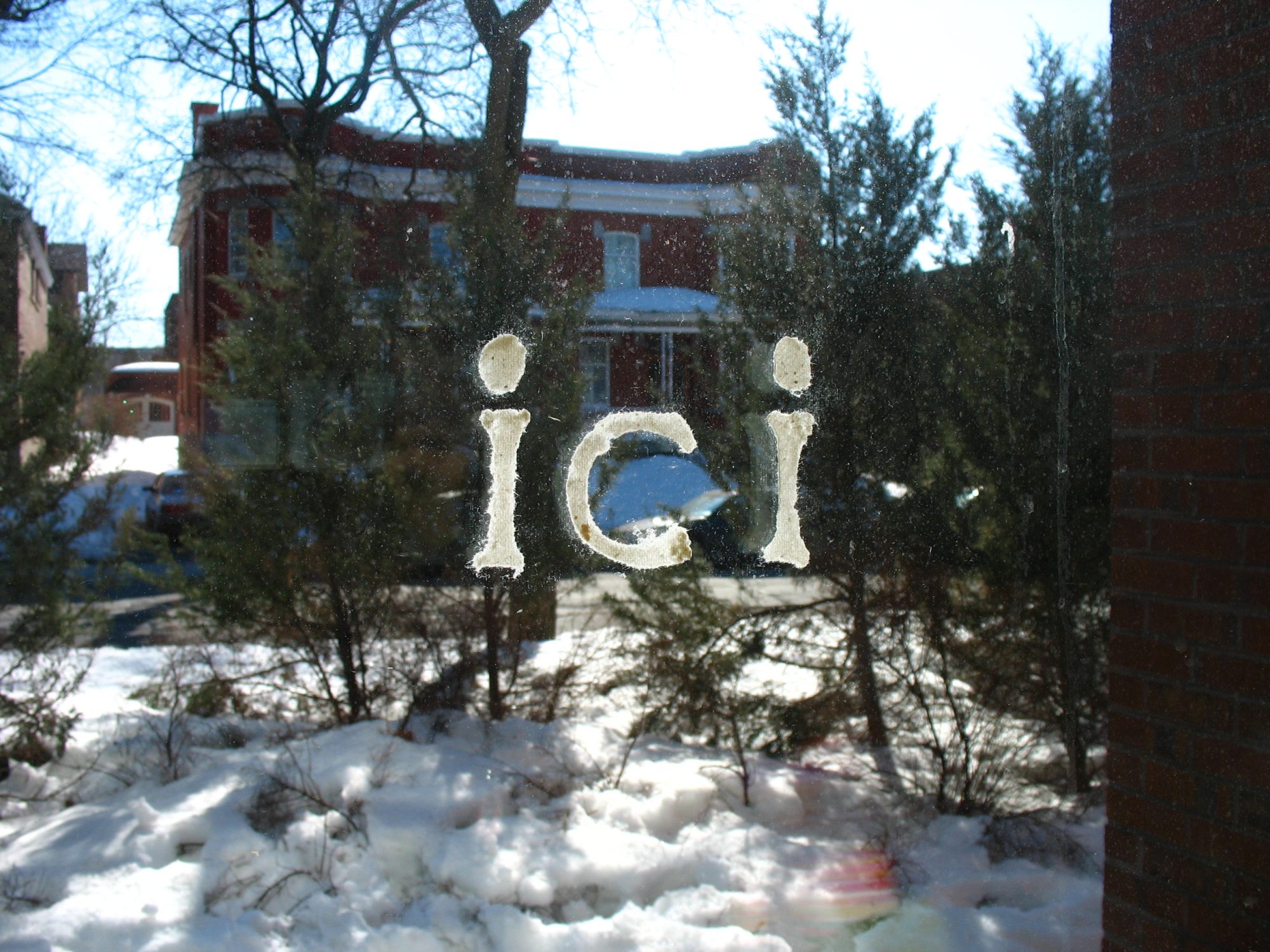
In the exhibition Où vont les mots, at La Galerie d’art d’Outremont, three interventions were made in the windows. To make these poems, paper pulp was attached directly onto the windows during the ‘couching’ process (transferring a wet sheet of paper pulp from the paper-making mold to a surface for drying). In some of the interventions, through a special technique, the letters were removed or prevented from forming on the mold during the paper making process before couching the paper to the window. In this way, it is the negative space or the absent space in the page that becomes the letter; sunlight shines through and the word can be read on the floor. The opposite is also used and only the word made of paper is couched on the window and hence, its shadow is cast on the floor or the window shade.

In one window we see a seemingly randomly placed cut out letters, which become legible on the floor of the gallery, when the sun shines through the handmade paper sheets, and we can read Où vont les mots. Under this work are sheets with upside-down and backwards cut-out letters; they spell out the same text with the light of the sun. Couched on another window are three letters made with paper pulp spelling the word “Ici” (here).


Dans le cadre de l’exposition Où vont les mots, à la Galerie d’art d’Outremont, trois interventions ont été réalisées dans les vitrines. Pour réaliser ces poèmes, la pâte à papier a été fixée directement sur le verre au cours du processus de couchage (transfert d’une feuille de pâte à papier humide du moule de fabrication du papier à une surface pour le séchage). Dans certaines interventions, grâce à une technique spéciale, les lettres ont été enlevées ou empêchées de se former sur le moule pendant le processus de fabrication du papier avant de coucher le papier sur la fenêtre. Ainsi, c’est l’espace négatif ou l’espace absent de la page qui devient la lettre; la lumière du soleil passe à travers et le mot peut être lu sur le sol. L’inverse est également utilisé et seul le mot en papier est couché sur la fenêtre et son ombre est donc projetée sur le sol ou sur le store de la fenêtre.

Dans une fenêtre, nous voyons des lettres découpées apparemment au hasard, qui deviennent lisibles sur le sol de la galerie, lorsque le soleil brille à travers les feuilles de papier faites à la main, et nous pouvons lire Où vont les mots. Sous cette œuvre se trouvent des feuilles avec des lettres découpées à l’envers et à l’endroit; elles épellent le même texte à la lumière du soleil. Sur une autre fenêtre, trois lettres fabriquées avec de la pâte à papier épellent le mot « Ici ».


Statement

On two separate occasions, Window Poems were interventions included in the exhibition Where the Words Go.  They are ephemeral and do not have titles of their own. They are often improvised on site for an exhibition. These works reference the ephemeral nature of language. The works of Where the words Go were a re-valuing of paper and its importance in supporting text.


À deux reprises, les Window Poems ont fait l’objet d’interventions dans le cadre de l’exposition Where the Words Go. Elles sont éphémères et n’ont pas de titre propre. Elles sont souvent improvisées sur place à l’occasion d’une exposition. Ces œuvres font référence à la nature éphémère du langage.

Les œuvres de Where the words Go ont permis de revaloriser le papier et son importance dans l’accompagnement du texte.


Karen Trask, 2024, Traduction : Mélissa Guay. 2025


Exhibition History

March 6 – March 30, 2008
Galerie d’art d’Outremont, Outremont, Québec, Canada
Description

The exhibition Où vont les mots proposes a dialogue between text and paper, and the landscape. It includes three artist books, two sculptures made from dictionaries, a paper poem installed on the window of the gallery and a large-format, composite mural of a snowy landscape, ink-jet printed onto paper made especially by the artist for this image. Shifu, the Japanese technique for spinning paper into paper threads is featured in these works. The work Portes was later transformed into Inside Passage / Passage intérieur, 2010.

In 2010, parts of this exhibition travelled to Grenfell Art Gallery (formerly known as Sir Wilfrid Grenier College Art Gallery) at Memorial University of Newfoundland in Corner Brook, and were exhibited in an exhibition entitled Where the Words Go curated by Charlotte Jones.

Statement

Where do words come from? Could letters of the alphabet be seeds for planting? The image of a woman blowing on a dandelion seed has been part of the cover design of The Larousse Dictionary for many years. Since I was a child, I have sensed words and letters existing like a river or a current of air floating all around me.

In Où vont les mots / Where the Words Go, hundreds of dictionaries have been dismantled and transformed into a series of sculptures and one giant mural. Their printed papers were either torn and recycled into fresh sheets of paper or reconstituted through spinning into long paper threads. A desire to subvert the power and authority of certain types of written texts and to highlight the presence of the paper used in printing these texts were the starting points for this work.

One sentence describes the objective of much of my work: I want to touch words; I want to touch the space between words. My creative process has developed as a series of poetic investigations exploring human experience through language. A love-hate relationship to the written word was born out of loss. When I was 6 years old, my mother died in a car accident. Learning to read and to write coincided with death. This marked the beginning of a dialogue with absence, that I have been exploring, breathing, falling into and ultimately searching for words to describe. Paper, normally the invisible and ignored support material is one of the materials I use to create this presence of absence. My creative process includes researching the etymological roots of words and experimenting with early textile arts technologies such as spinning and weaving. Knowing the stories behind the evolution of words such as: text, (from textus meaning textile in Latin,) to spin, (to draw out of chaos, Latin,) stitch or suture (Sanskrit, word sutra, meaning thread and narrative scriptures) is an important part of this process.

“For over 20,000 years until the industrial revolution, the textile arts were an enormous economic force belonging primarily to women. Because of the perishability of these products, much of this contribution did not find its way into history books. Before writing became the principle means of communicating and recording information, clothing and textiles provided a place for social messages.” ( E. Wayland Barber, Women’s Work)

The spinning in this project is a reminder of this contribution – a remembering through the fingers. In Où vont les mots / Where the Words Go, I am creating space for my own sculptural writing.

Karen Trask, 2008