Description
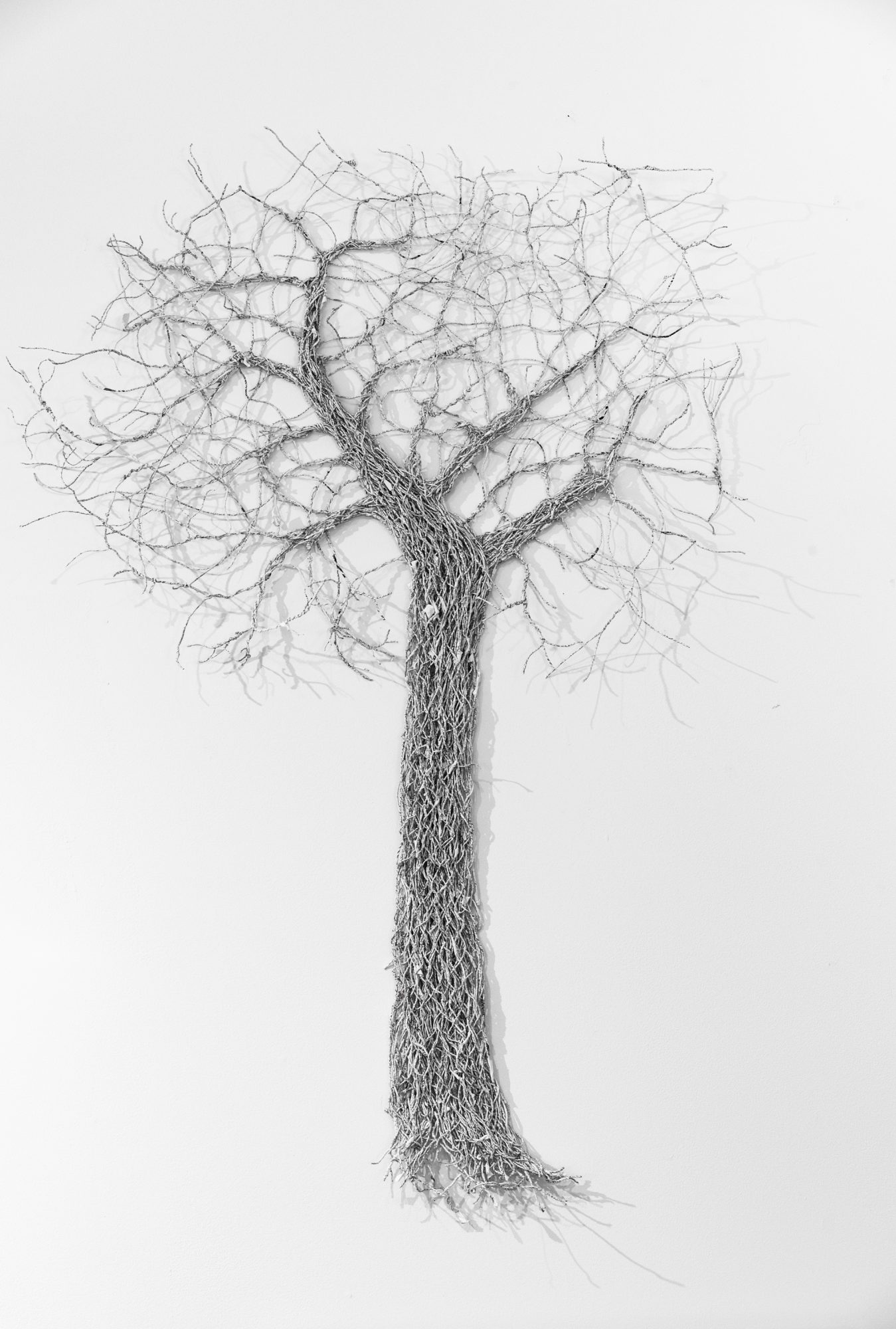
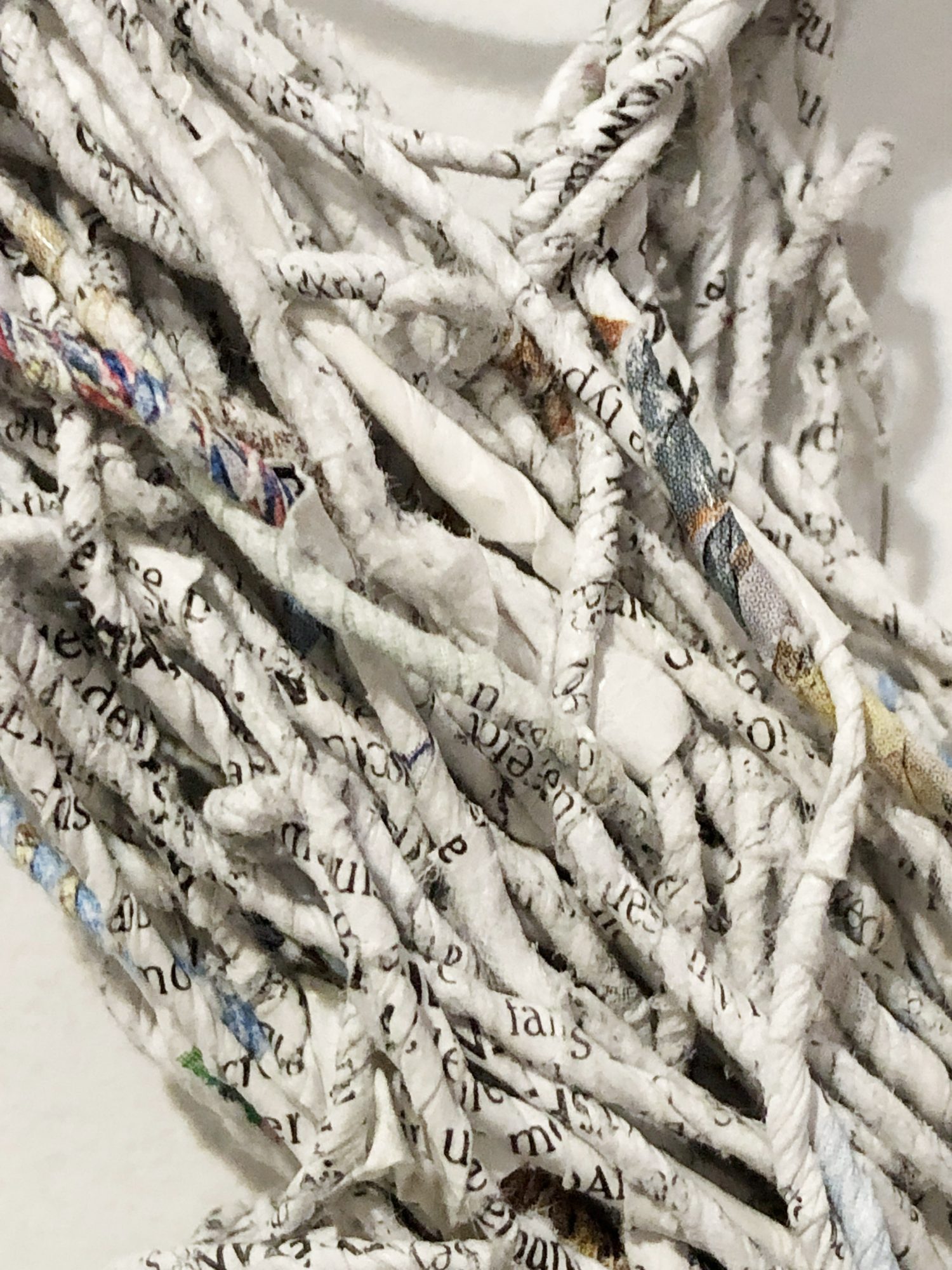
Tree of Knowledge is composed of many threads of dictionary paper interwoven in the shape of a tree.
Using the Japanese technique Shifu for spinning paper into threads, the pages from the Petit Larousse Illustré dictionary were spun into paper threads. To give the threads structure and strength, they were core spun over a fine wire. These threads were then woven and twisted together to create the replica of a tree growing in the artist’s neighbourhood.
Tree of Knowledge est composé de plusieurs fils de papier dictionnaire entrelacés en forme d’arbre.
En utilisant la technique japonaise Shifu de filage du papier, les pages du dictionnaire Petit Larousse Illustré ont été filées en fils de papier. Pour donner aux fils leur structure et leur résistance, ils ont été filés sur un fil en acier fin. Ces fils ont ensuite été tissés et tordus ensemble pour créer la réplique d’un arbre poussant dans le quartier de l’artiste.
Statement
Experimenting with ancient technologies of the textile arts such as spinning, weaving and papermaking is an integral part of my approach to making art. Text in the word textile and expressions such as spinning tales reveal the historical connections between story telling, writing and early textile arts that are still alive today in our words and expressions.
Trees hide in the etymology of words such as library from the Latin liber meaning wood, or in book from the Anglo Saxon word bok meaning beech tree.
Paper, normally the invisible and often ignored surface for writing is my material of choice. It is easy to forget where paper comes from. In this work, I am remembering that paper and books have their roots in the tree.
L’expérimentation des anciennes technologies des arts textiles, telles que le filage, le tissage et la fabrication de papier, fait partie intégrante de mon approche artistique. Le texte dans le mot « textile » et les expressions comme « le fil de l’histoire » révèlent les liens historiques entre la mise en récit, l’écriture et les premiers arts textiles, qui sont encore vivants aujourd’hui dans nos mots et nos expressions.
Les arbres se cachent dans l’étymologie de mots tels que librairie, du latin liber signifiant bois, ou book (livre), du mot anglo-saxon bok signifiant hêtre.
Le papier, qui est normalement la surface invisible et souvent ignorée de l’écriture, est mon matériau de prédilection. Il est facile d’oublier l’origine du papier. Dans ce travail, je me souviens que le papier et les livres ont leurs racines dans l’arbre.